Weather Alert in Wisconsin
Blizzard Warning issued March 15 at 2:15AM CDT until March 16 at 7:00AM CDT by NWS La Crosse WI
AREAS AFFECTED: Taylor; Clark; Buffalo; Trempealeau; Jackson
DESCRIPTION: ...DANGEROUS WINTER STORM TO IMPACT THE REGION THROUGH MONDAY MORNING... .A dangerous and potentially historic winter storm will impact the region through Monday morning. Snow rates north of Interstate 90 will increase throughout the overnight. By early this morning snowfall rates of 2 to 4 inches per hour are likely across portions of northern Clark and Taylor Counties. Mixed precipitation is likely near I-90 this morning where freezing rain accumulations of one to three tenths of an inch of ice is likely. By this afternoon, much of the area will switchover to snow with wind gusts increasing to 35 to 55 mph. This will result in widespread visibilities reductions to 1/4 mile or less at times where the Blizzard Warning is in effect. Storm total snow accumulations will likely approach all-time records in north-central Wisconsin with 18 to 36 inches of snow expected north of Interstate 94. Travel will be impossible for much of the area throughout the storm. Any travel should be reserved for emergencies only. Power outages and tree damage will be possible with the combination of heavy snow, ice, and increasing winds today. * WHAT...For the Winter Storm Warning, heavy mixed precipitation. Additional snow and sleet accumulations between 3 and 11 inches and ice accumulations around a light glaze. Winds gusting as high as 40 mph. For the Blizzard Warning, blizzard conditions expected. Total snow accumulations between 8 and 11 inches. Winds gusting as high as 45 mph. * WHERE...Clark, Taylor, Buffalo, Jackson, and Trempealeau Counties. * WHEN...For the Winter Storm Warning, until 10 AM CDT this morning. For the Blizzard Warning, from 10 AM this morning to 7 AM CDT Monday. * IMPACTS...Travel could be very difficult to impossible. Widespread blowing snow could significantly reduce visibility. The hazardous conditions could impact the Monday morning commute. Gusty winds could bring down tree branches.
INSTRUCTION: If you must travel, keep an extra flashlight, food, and water in your vehicle in case of an emergency. Visit 511wi.gov for road conditions. Travel should be restricted to emergencies only. If you must travel, have a winter survival kit with you. If you get stranded, stay with your vehicle. In Minnesota, visit 511mn.org for road conditions. In Wisconsin, visit 511wi.gov for road conditions.
Want more detail? Get the Complete 7 Day and Night Detailed Forecast!
Current U.S. National Radar--Current
The Current National Weather Radar is shown below with a UTC Time (subtract 5 hours from UTC to get Eastern Time).

National Weather Forecast--Current
The Current National Weather Forecast and National Weather Map are shown below.

National Weather Forecast for Tomorrow
Tomorrow National Weather Forecast and Tomorrow National Weather Map are show below.

North America Water Vapor (Moisture)
This map shows recent moisture content over North America. Bright and colored areas show high moisture (ie, clouds); brown indicates very little moisture present; black indicates no moisture.

Weather Topic: What are Cirrocumulus Clouds?
Home - Education - Cloud Types - Cirrocumulus Clouds
 Next Topic: Cirrostratus Clouds
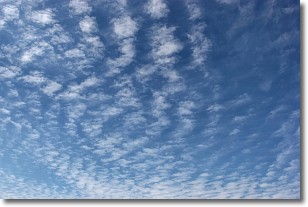
Cirrocumulus clouds form at high altitudes (usually around 5 km)
and have distinguishing characteristics displayed in a fine layer of
small cloud patches. These small cloud patches are sometimes referred to as
"cloudlets" in relation to the whole cloud formation.
Cirrocumulus clouds are formed from ice crystals and water droplets. Often, the
water droplets in the cloud freeze into ice crystals and the cloud becomes a
cirrostratus cloud. Because of this common occurrence, cirrocumulus cloud
formations generally pass rapidly.
Next Topic: Cirrostratus Clouds
Weather Topic: What are Cirrus Clouds?
Home - Education - Cloud Types - Cirrus Clouds
 Next Topic: Condensation
Cirrus clouds are high-level clouds that occur above 20,000 feet
and are composed mainly of ice crystals.
They are thin and wispy in appearance.
What do they indicate?
They are often the first sign of an approaching storm.
Next Topic: Condensation
Current conditions powered by WeatherAPI.com