Weather Alert in Montana
Fire Weather Watch issued March 23 at 11:14PM MDT until March 25 at 9:00PM MDT by NWS Billings MT
AREAS AFFECTED: Beartooth Ranger District Custer National Forest; Golden Valley County/Musselshell County; Yellowstone County; Crow Indian Reservation/Big Horn Canyon Rec Area; Sheridan County/Casper BLM
DESCRIPTION: * IMPACTS: Low humidities, unseasonably warm temperatures, strong gusty winds, and wind shift with a cold front will create erratic fire behavior and new fire starts. * AFFECTED AREA: In North Central WY Fire Zone...274. In South Central MT Fire Zones...126...127...128...129.For Zones 126, 127, and 129, the worst conditions will impact the lower elevations where grasses remain dead or dry. * COUNTIES AFFECTED: In Central MT...Golden Valley...Musselshell. In North Central WY...Sheridan. In South Central MT...Big Horn...Carbon...Park...Stillwater Sweet Grass...Yellowstone. * COLD FRONT: Frontal passage is forecast Wednesday evening, bringing an end to the gusty conditions and a shift from the west to the north-northeast. Light showers are possible behind the front, although the chance of a wetting rain is low. * WIND: West 15 to 25 mph with gusts up to 45 mph. * HUMIDITY: As low as 15 percent. In Sheridan County, as low as 7 percent. * TEMPERATURES: Up to 83.
INSTRUCTION: A Fire Weather Watch means that critical fire weather conditions are forecast to occur. Listen for later forecasts and possible Red Flag Warnings.
Want more detail? Get the Complete 7 Day and Night Detailed Forecast!
Current U.S. National Radar--Current
The Current National Weather Radar is shown below with a UTC Time (subtract 5 hours from UTC to get Eastern Time).

National Weather Forecast--Current
The Current National Weather Forecast and National Weather Map are shown below.

National Weather Forecast for Tomorrow
Tomorrow National Weather Forecast and Tomorrow National Weather Map are show below.

North America Water Vapor (Moisture)
This map shows recent moisture content over North America. Bright and colored areas show high moisture (ie, clouds); brown indicates very little moisture present; black indicates no moisture.

Weather Topic: What are Stratocumulus Clouds?
Home - Education - Cloud Types - Stratocumulus Clouds
 Next Topic: Stratus Clouds
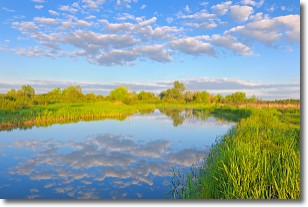
Stratocumulus clouds are similar to altocumulus clouds in their
fluffy appearance, but have a slightly darker shade due to their additional mass.
A good way to distinguish the two cloud types is to hold your hand out and measure
the size of an individual cloud; if it is the size of your thumb it is generally
an altocumulus cloud, if it is the size of your hand it is generally a
stratocumulus cloud.
It is uncommon for stratocumulus clouds to produce precipitation, but if they do
it is usually a light rain or snow.
Next Topic: Stratus Clouds
Weather Topic: What are Wall Clouds?
Home - Education - Cloud Types - Wall Clouds
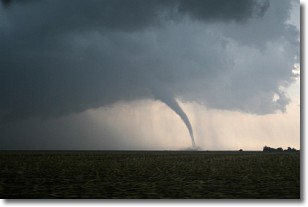 Next Topic: Altocumulus Clouds
A wall cloud forms underneath the base of a cumulonimbus cloud,
and can be a hotbed for deadly tornadoes.
Wall clouds are formed by air flowing into the cumulonimbus clouds, which can
result in the wall cloud descending from the base of the cumulonimbus cloud, or
rising fractus clouds which join to the base of the storm cloud as the wall cloud
takes shape.
Wall clouds can be very large, and in the Northern Hemisphere they generally
form at the southern edge of cumulonimbus clouds.
Next Topic: Altocumulus Clouds
Current conditions powered by WeatherAPI.com