Weather Alert in Wisconsin
Winter Storm Warning issued April 1 at 3:11AM CDT until April 2 at 12:00PM CDT by NWS Twin Cities/Chanhassen MN
AREAS AFFECTED: St. Croix; Pierce; Dunn; Pepin; Chippewa; Eau Claire
DESCRIPTION: ...MESSY SPRING SYSTEM BRINGS FREEZING RAIN, SLEET, AND SNOWTO PORTIONS OF MINNESOTA AND WISCONSIN TONIGHT THROUGH THURSDAY... .A strong spring system brings a variety of precipitation types to the region tonight through Thursday. While there is still some uncertainty in the exact track of the low, mainly snow & sleet is expected across central Minnesota, while a mix of freezing rain, sleet, & snow is expected for southern Minnesota, the Twin Cities metro, & western Wisconsin. The greatest travel impacts are expected across eastern Minnesota & west-central Wisconsin where icing amounts around 0.25" are likely, along with sleet & snow at times. This will lead to very slick roads, as well as the possibility of some downed tree branches & power outages. Elsewhere, freezing rain accumulations around 0.1" along with an inch or two of sleet & snow will lead to slick roads late Wednesday night through Thursday morning. * WHAT...Heavy mixed precipitation expected. Total snow accumulations up to one inch, sleet accumulations around three quarters of an inch, and ice accumulations around one quarter of an inch. Winds gusting as high as 30 mph. * WHERE...Chippewa, Dunn, Eau Claire, Pepin, Pierce, and St. Croix Counties. * WHEN...From midnight tonight to noon CDT Thursday. * IMPACTS...Roads, and especially bridges and overpasses, will likely become slick and hazardous. Plan on slippery road conditions. The hazardous conditions will impact the Wednesday evening and Thursday morning commutes. Ice accumulation on power lines and tree limbs may cause isolated power outages.
INSTRUCTION: If you must travel, keep an extra flashlight, food, and water in your vehicle in case of an emergency. In Minnesota, call 5 1 1 or visit 511mn.org for road conditions. In Wisconsin, call 5 1 1 or visit 511wi.gov for road conditions.
Want more detail? Get the Complete 7 Day and Night Detailed Forecast!
Current U.S. National Radar--Current
The Current National Weather Radar is shown below with a UTC Time (subtract 5 hours from UTC to get Eastern Time).

National Weather Forecast--Current
The Current National Weather Forecast and National Weather Map are shown below.

National Weather Forecast for Tomorrow
Tomorrow National Weather Forecast and Tomorrow National Weather Map are show below.

North America Water Vapor (Moisture)
This map shows recent moisture content over North America. Bright and colored areas show high moisture (ie, clouds); brown indicates very little moisture present; black indicates no moisture.

Weather Topic: What is Sleet?
Home - Education - Precipitation - Sleet
 Next Topic: Snow
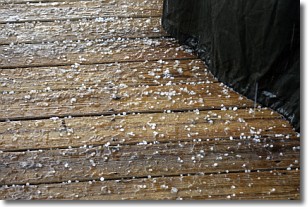
Sleet is a form of precipitation in which small ice pellets are the primary
components. These ice pellets are smaller and more translucent than hailstones,
and harder than graupel. Sleet is caused by specific atmospheric conditions and
therefore typically doesn't last for extended periods of time.
The condition which leads to sleet formation requires a warmer body of air to be
wedged in between two sub-freezing bodies of air. When snow falls through a warmer
layer of air it melts, and as it falls through the next sub-freezing body of air
it freezes again, forming ice pellets known as sleet. In some cases, water
droplets don't have time to freeze before reaching the surface and the result is
freezing rain.
Next Topic: Snow
Weather Topic: What are Stratocumulus Clouds?
Home - Education - Cloud Types - Stratocumulus Clouds
 Next Topic: Stratus Clouds
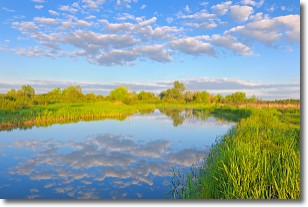
Stratocumulus clouds are similar to altocumulus clouds in their
fluffy appearance, but have a slightly darker shade due to their additional mass.
A good way to distinguish the two cloud types is to hold your hand out and measure
the size of an individual cloud; if it is the size of your thumb it is generally
an altocumulus cloud, if it is the size of your hand it is generally a
stratocumulus cloud.
It is uncommon for stratocumulus clouds to produce precipitation, but if they do
it is usually a light rain or snow.
Next Topic: Stratus Clouds
Current conditions powered by WeatherAPI.com