Weather Alert in Colorado
Winter Storm Warning Winter Weather Advisory
Special Weather Statement issued February 18 at 12:38PM MST by NWS Grand Junction CO
AREAS AFFECTED: Roan and Tavaputs Plateaus; Grand Valley; Uncompahgre Plateau/Dallas Divide; Paradox Valley/Lower Dolores River; Tavaputs Plateau; Arches/Grand Flat; La Sal and Abajo Mountains
DESCRIPTION: At 1238 PM MST, Doppler radar was tracking strong thunderstorms along a line extending from 31 miles north of Castle Valley to 14 miles west of Slick Rock. Movement was east at 40 mph. HAZARD...Wind gusts of 50 to 55 mph. SOURCE...Radar indicated. IMPACT...Gusty winds could knock down tree limbs and blow around unsecured objects. Locations impacted include... Castle Valley, La Sal, Nucla, Naturita, Slick Rock, Paradox, Vancorum, Bedrock, Gateway, Summit Point, Mack, Cisco, and Uravan. This includes the following highways... Interstate 70 in Colorado between mile markers 1 and 15. Interstate 70 in Utah between mile markers 202 and 231. Utah 128 between mile markers 18 and 44. Colorado 90 between mile markers 1 and 33. Colorado 141 near mile marker 24, between mile markers 44 and 51, and between mile markers 57 and 132.
INSTRUCTION: If outdoors, consider seeking shelter inside a building.
Want more detail? Get the Complete 7 Day and Night Detailed Forecast!
Current U.S. National Radar--Current
The Current National Weather Radar is shown below with a UTC Time (subtract 5 hours from UTC to get Eastern Time).

National Weather Forecast--Current
The Current National Weather Forecast and National Weather Map are shown below.

National Weather Forecast for Tomorrow
Tomorrow National Weather Forecast and Tomorrow National Weather Map are show below.

North America Water Vapor (Moisture)
This map shows recent moisture content over North America. Bright and colored areas show high moisture (ie, clouds); brown indicates very little moisture present; black indicates no moisture.

Weather Topic: What are Stratus Clouds?
Home - Education - Cloud Types - Stratus Clouds
 Next Topic: Wall Clouds
Stratus clouds are similar to altostratus clouds, but form at a
lower altitude and are identified by their fog-like appearance, lacking the
distinguishing features of most clouds.
Stratus clouds are wider than most clouds, and their base has a smooth, uniform
look which is lighter in color than a nimbostratus cloud.
The presence of a stratus cloud indicates the possibility of minor precipitation,
such as drizzle, but heavier precipitation does not typically arrive in the form
of a stratus cloud.
Next Topic: Wall Clouds
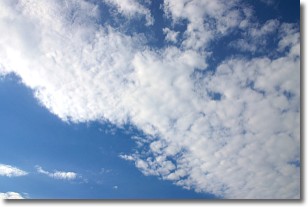
Weather Topic: What are Altocumulus Clouds?
Home - Education - Cloud Types - Altocumulus Clouds
 Next Topic: Altostratus Clouds
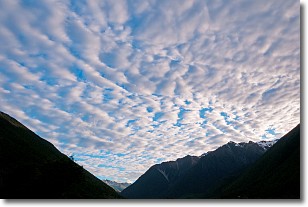
Similar to cirrocumulus clouds, altocumulus clouds are
characterized by cloud patches. They are distinguished by larger cloudlets
than cirrocumulus clouds but are still smaller than stratocumulus clouds.
Altocumulus clouds most commonly form in middle altitudes (between 2 and 5 km)
and may resemble, at times, the shape of a flying saucer.
These uncommon formations, called altocumulus lenticularis, are created by uplift
in the atmosphere and are most often seen in close proximity to mountains.
Next Topic: Altostratus Clouds
Current conditions powered by WeatherAPI.com